
Let’s talk plainly, the way your favourite uncle would talk to you over pepper soup. Your heart is not Nepa. It does not take a break, it does not take light and come back later. It works every second, every minute, all day and all night, from the day you were formed in your mother’s womb until the day you draw your last breath. So when we talk about a heart attack, formally called myocardial infarction, we are talking about the one organ in your body that has no off switch, suddenly starved of the one thing it cannot survive without: blood full of oxygen.
So What Exactly Is Happening in There?
Picture the coronary arteries as the good old Third Mainland Bridge, carrying blood like traffic to feed your heart muscle. Over the years, fatty deposits made of cholesterol, fat and calcium build up quietly along the walls of this bridge, much like potholes nobody has bothered to fix. This buildup is called atherosclerosis, and it usually happens without a single symptom, which is exactly why it is so dangerous.
Then one day, a piece of that fatty plaque cracks or ruptures. The body, thinking there is an injury to heal, rushes blood cells to the spot to form a clot. Except this repair job ends up blocking the artery completely, and the part of the heart muscle downstream of that blockage is suddenly cut off from oxygen. This is essentially the natural progression from atherosclerosis and angina to a full infarction. Once a clot forms and completely blocks blood supply, the result is the classic crushing chest pain that can spread to the arm or jaw. Deprived cells do not wait patiently for help. They start to die. That is your heart attack.
Doctors split this into two categories depending on what the ECG shows: a complete blockage known as STEMI, or a partial one known as NSTEMI. Both fall under the umbrella of acute myocardial infarction, a critical cardiovascular emergency defined by the death of heart tissue from a sudden interruption of coronary blood flow, and both remain leading causes of illness and death worldwide.
The Warning Signs, Please Do Not Manage It Like Malaria
A lot of Nigerians feel chest discomfort and quietly reach for Alabukun or hot water and rest, hoping it settles on its own. Please do not gamble with this one. The classic warning signs include chest pain or discomfort that can spread to the jaw, neck, shoulder, arm or back, along with shortness of breath, cold sweats or nausea. It is entirely possible to have a heart attack without any chest pain at all, especially in women, diabetics and the elderly. If any of these signs show up suddenly and refuse to go, get to a hospital immediately. Every minute of delay is heart muscle you can never get back.
What Happens When You Reach the Hospital
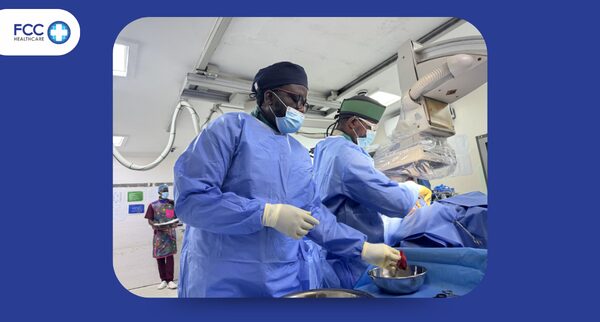
Doctors have a simple, almost military approach for the first line of attack, remembered by the acronym MONA. Morphine relieves pain, Oxygen supports the starving heart tissue, Nitroglycerin widens the vessels and eases the heart’s workload, and Aspirin stops the clot from growing further. From there, if the blockage is confirmed, the goal is to reopen that artery as fast as possible, either with clot busting drugs or, more commonly today, a trip to the cath lab for angioplasty and stenting, which we explain fully in the companion piece on cath procedures. Blood tests matter enormously here too. A protein called troponin, which leaks out when heart cells are damaged, rises within hours of an infarction and remains one of the most reliable markers doctors use to confirm the diagnosis.
Why This Matters More for Us, Right Here in Nigeria
Some people assume heart attacks are an oyinbo or Western problem, tied to fast food and cold weather. That assumption will not save your life. Cardiovascular disease prevalence in Nigeria has been estimated as high as seventy six percent, with a mortality rate around ten percent, and the disease burden measured in years lived with disability actually rose between 2019 and 2022. Key drivers among Nigerians include hypertension affecting roughly three in ten adults, overweight and obesity, diabetes, tobacco use, and, worth noting for a nation that loves its rice and swallow, an unhealthy diet reported in close to three quarters of at risk populations, alongside alarmingly low levels of physical activity.
A sobering hospital based review out of Lagos found that out of over twenty one thousand medical admissions across sixteen years, cardiovascular cases made up roughly one fifth of them and nearly a third of all deaths on the wards, with stroke and heart failure being the two biggest contributors. On a recent World Heart Day, Nigerian cardiologists sounded the alarm that cardiovascular disease now accounts for a substantial share of yearly deaths in the country, with hypertension prevalence having jumped from around four million affected Nigerians in 1995 to over twenty seven million by 2020, and still climbing.
The Nigerian Uncle’s Guide to Prevention
You do not need a gym membership in Lekki to protect your heart. You need consistency.
- Check your blood pressure regularly, not just when you feel dizzy. Hypertension is the quiet engineer of most heart attacks.
- Cut down the salt and the fried everything, yes, including that beloved bowl of jollof swimming in oil.
- Move your body. A brisk walk round the estate every evening counts.
- Know your family history. If heart disease runs in your bloodline, you do not get to be casual about it.
- Do not smoke. If you drink alcohol, it is advisable to significantly reduce your intake or don’t drink at all.
- Take chest pain seriously. Not every chest pain is gas. When in doubt, go and check it out.
Your heart has carried you this far without asking for a single day off. The least you can do is give it a fighting chance.